We’ve all met someone who speaks with such confidence you think “They must know what they’re talking about.” But when it comes to health, confidence is often not an indication of expertise.
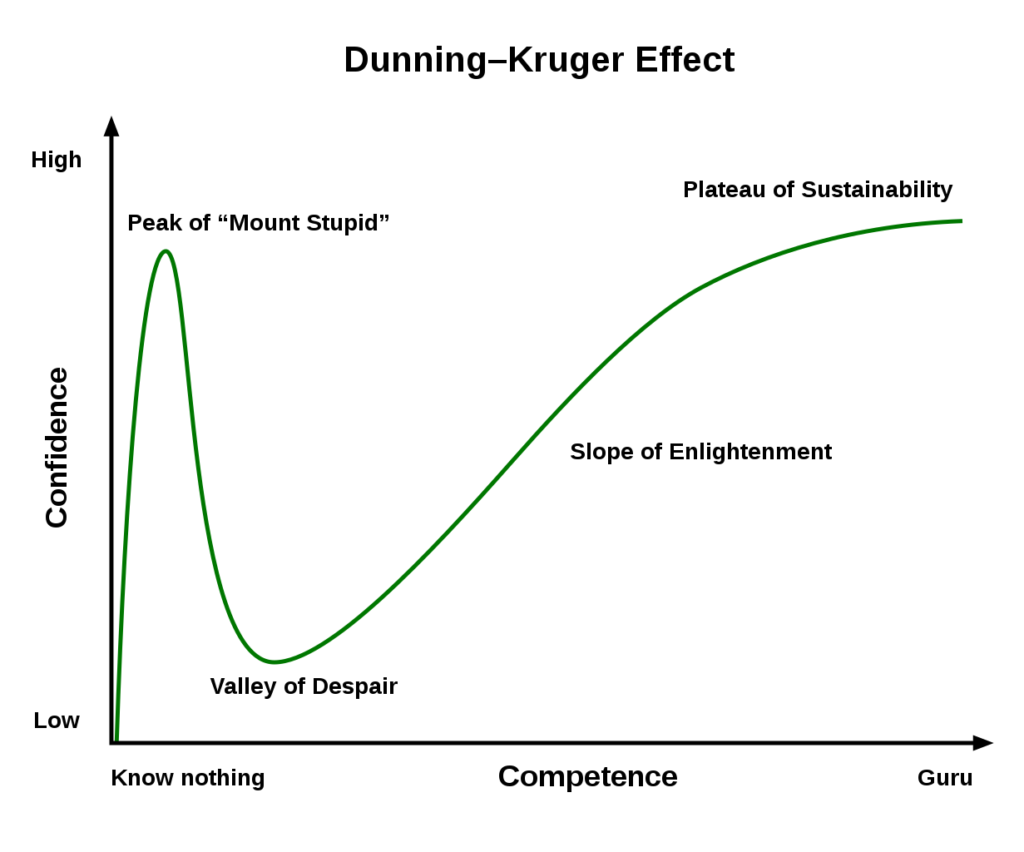
Humans have a tendency when learning new knowledge to feel as though they have suddenly become experts. However, after continuing to explore a topic deeply their confidence subsides as they realize how extensive that topic is and how much they still have to learn.
You will find someone who understands the deeper complexities of a subject may appear less confident. This comes from that deeper understanding of the various pitfalls and traps which remain hidden to a new learner, but become clear as they understand how much more there is to take into account.
This applies in no small way to the application of natural medicines, as at their core, their unrefined state beings a level of complexity a new learner is completely unaware of.
This is known as the Dunning–Kruger effect1 where people with limited knowledge in an area feel very confident in their understanding and are not shy about telling you about it. Kruger and Dunning (1999) identified that unaccomplished individuals do not possess the cognitive skills necessary to accurately self-assess while their more accomplished counterparts do, but this process makes them appear less confident.
Interestingly, and perhaps confusingly, the conversation goes both ways. People with that deeper understanding can sometimes underestimate their ability, because they have come to realise just how much there is to know.
This is why it is important to be aware of the qualifications of those you are listening to. In a world where social media can have such a big influence, the Dunning-Kruger effect is one that is worth being aware of. As those who are out there talking loudly about the latest trends, may not always be the ones who actually understand them.
- Kruger J, Dunning D. Unskilled and unaware of it: How difficulties in recognizing one’s own incompetence lead to inflated self-assessments. Journal of Personality and Social Psychology. 1999;77(6):1121–34.